
Speakmac vs Wispr Flow: Our July 2026 Same-Audio Test
By Kiran Jd
Published · Updated
By Kiran Jd
Published · Updated
| What matters | Speakmac | Wispr Flow |
|---|---|---|
| Real speech in this test | 6.3% WER; 37/37 total outputs | 6.3% WER; 35/37 total outputs |
| When both returned real speech | 6.1% WER | 4.4% WER |
| Text tendency | More literal; keeps corrections | More editorial; cleaner formatting |
| Processing tested | Local recognition and local cleanup | Cloud dictation |
| Individual price checked July 28, 2026 | $29 one-time for 1 Mac; ₹699 in India | $15/month or $12/month annually; ₹400/month or ₹320/month annually in India |
Historical benchmark: The head-to-head run was July 28, 2026. The August check below reran Speakmac only. These results do not establish how the latest versions compare today. Product links reviewed September 5, 2026; no new head-to-head test was performed.
We played the same 37 audio files into Speakmac and Wispr Flow: 27 real human recordings, 10 controlled stress tests, 656 reference words, and 4 minutes 50 seconds of speech.
On the real recordings, both finished at 6.3% word error rate. That exact tie is arithmetic, not proof that the apps are identical. Wispr Flow was slightly more accurate on the 26 real clips where both returned text: 4.4% versus 6.1%. Speakmac returned text on all 37 tests; Wispr Flow returned text on 35.
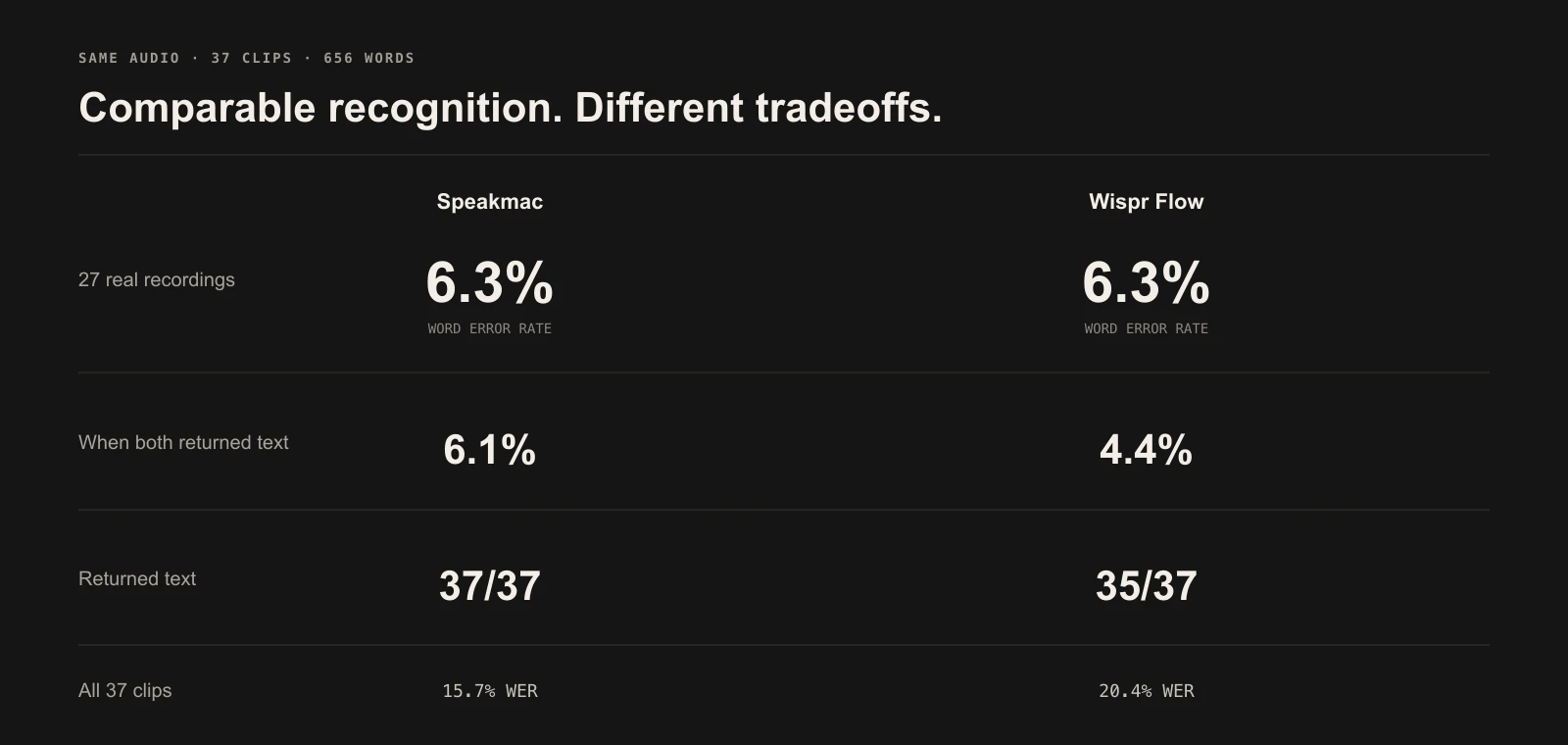
Wispr Flow had a small conditional edge on real speech and produced cleaner edited text. Speakmac returned more outputs in this run and preserved more of the spoken wording.
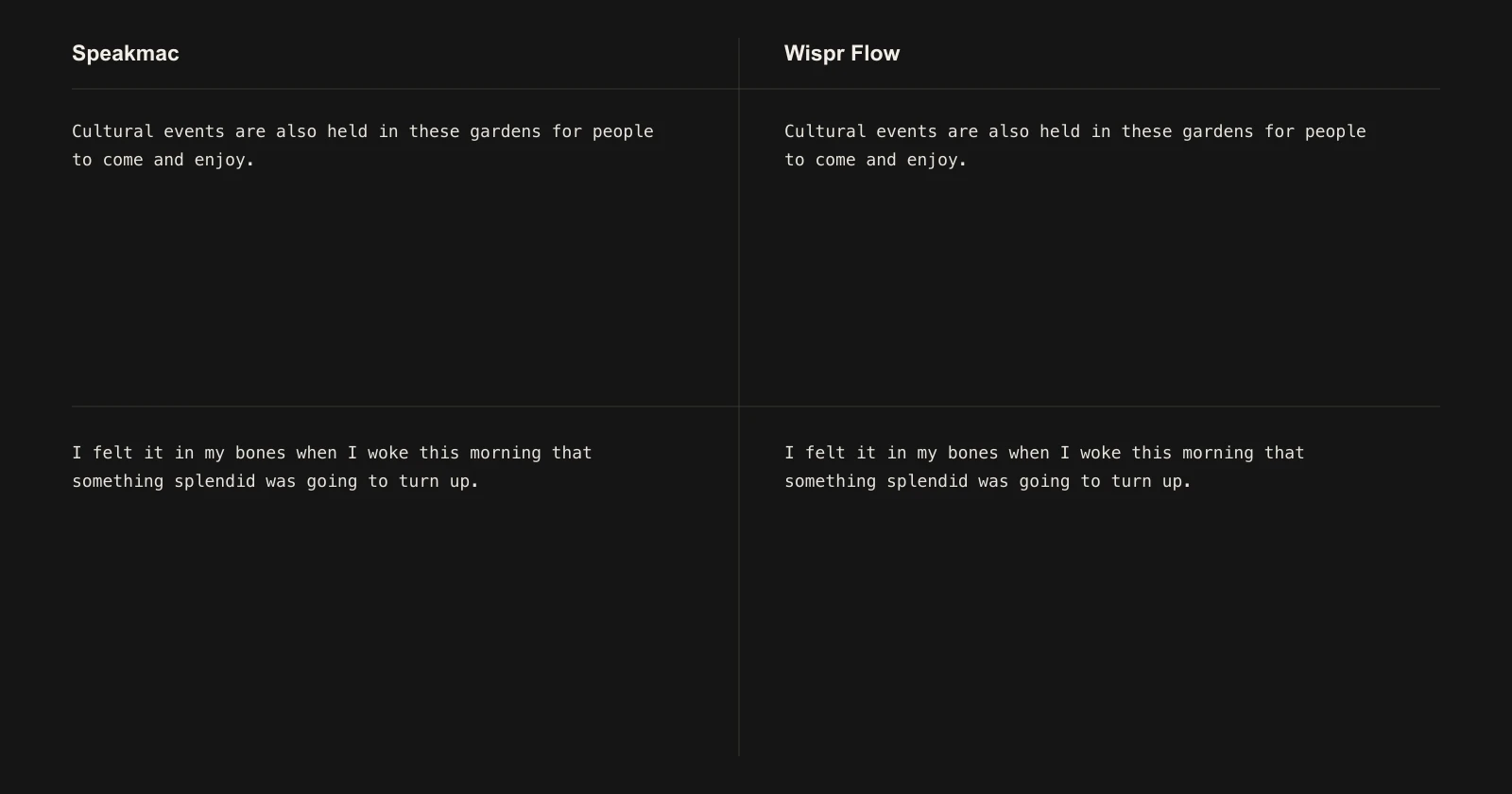
Both often returned the same sentence.
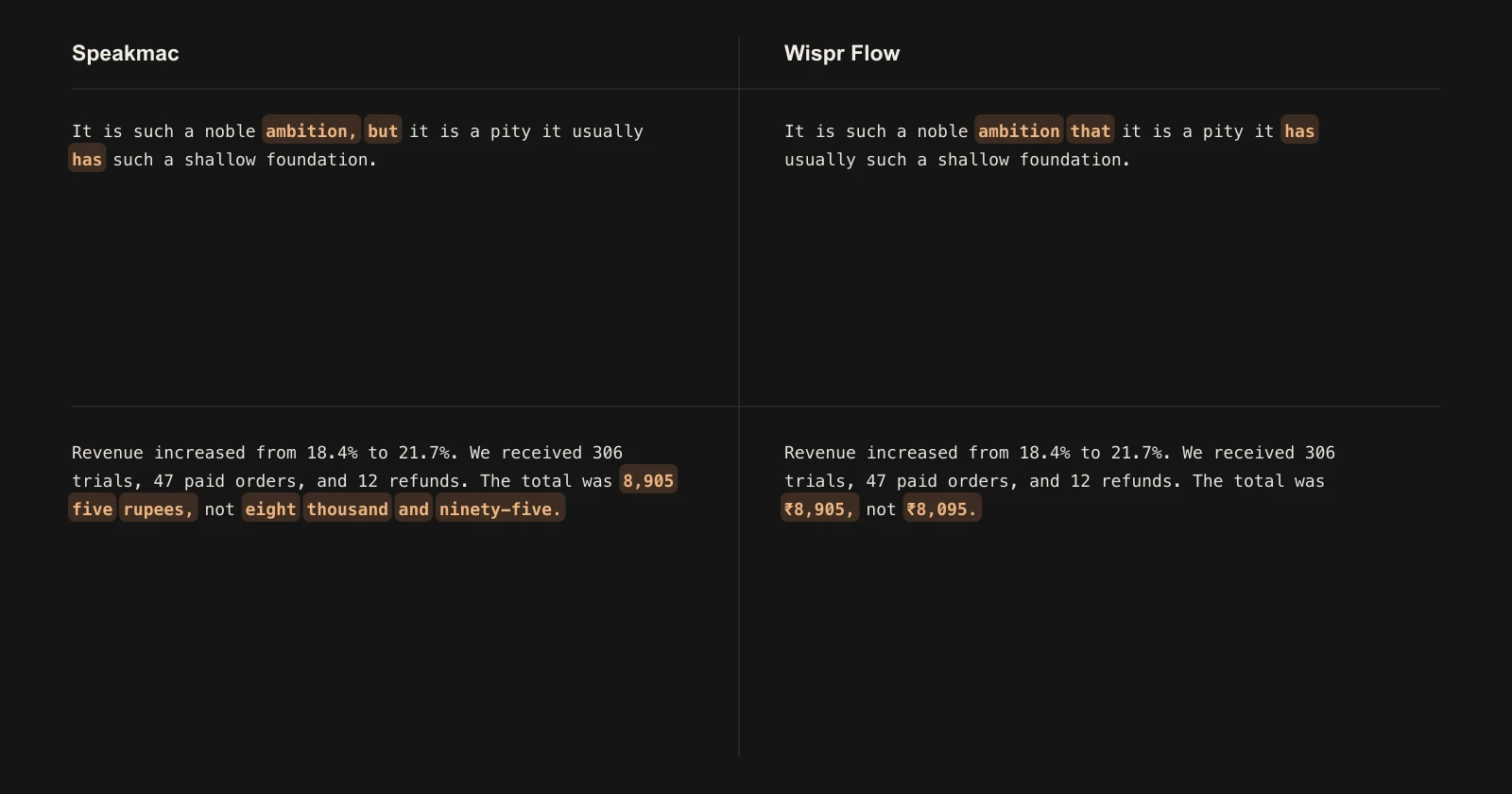
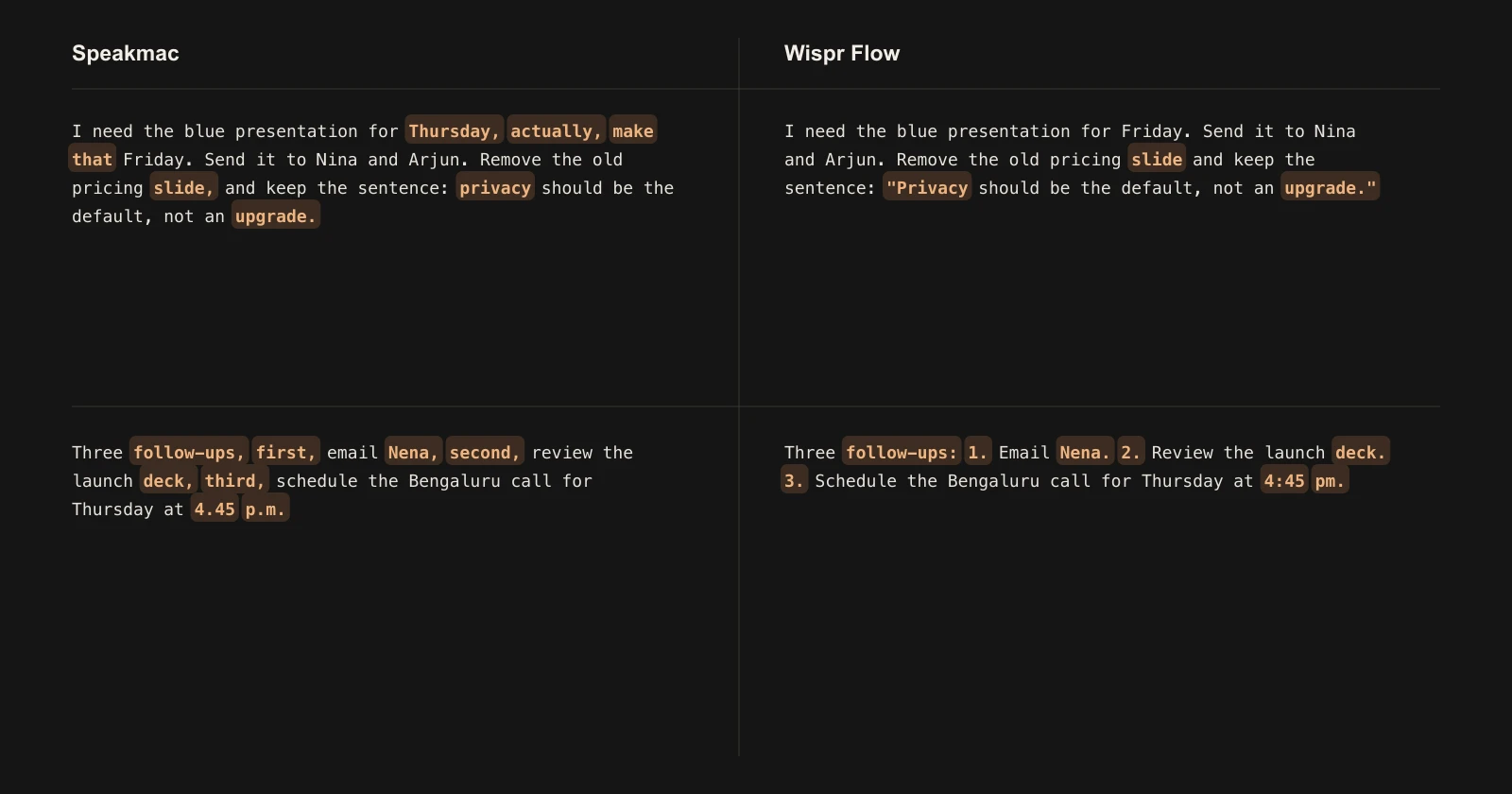
Wispr Flow was better when its editing helped. It preserved one real sentence that Speakmac rewrote, and it formatted money and percentages much more cleanly.
Speakmac was better on some difficult names, paths, and identifiers. Neither app was consistently safe for exact proper nouns or codes.
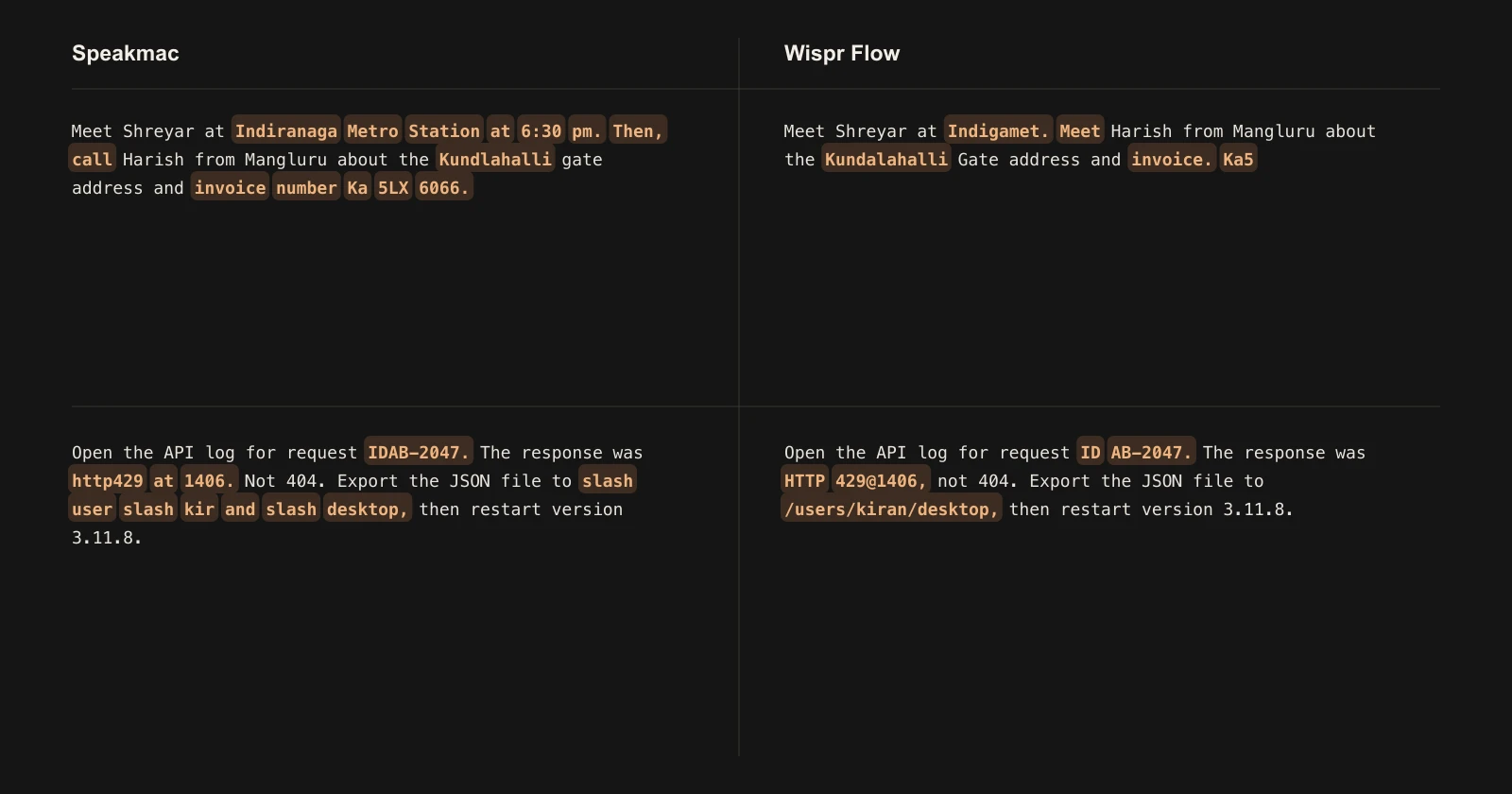
The two apps also make different editorial choices. Speakmac usually keeps the spoken correction trail. Wispr Flow may collapse it into the final intent or restructure speech into a list.
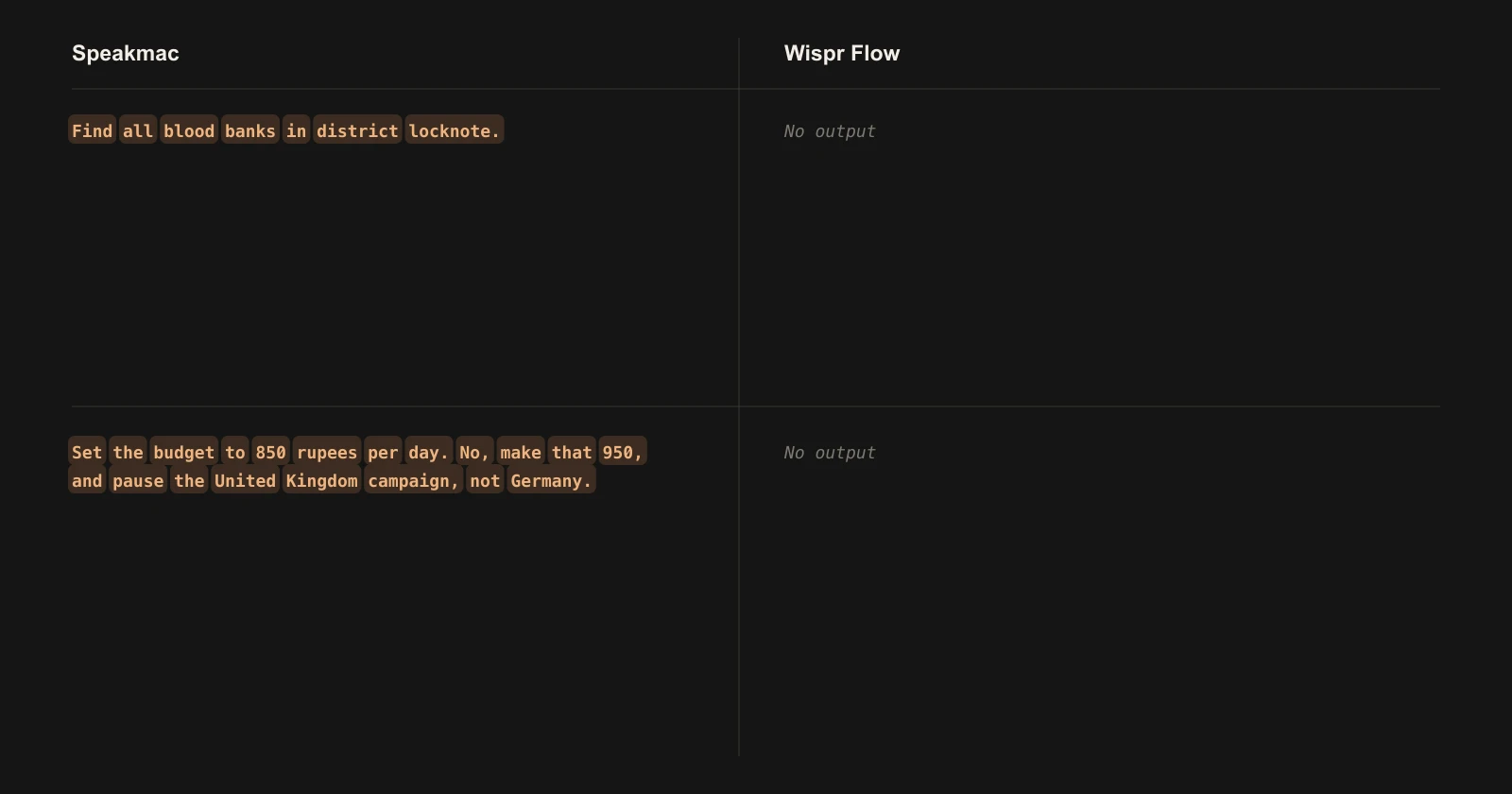
Wispr Flow produced no inserted text on two clean attempts. One was real Indian-English speech; the other was a controlled correction. We restarted Flow, confirmed the audio route, and retried before counting either as no output.
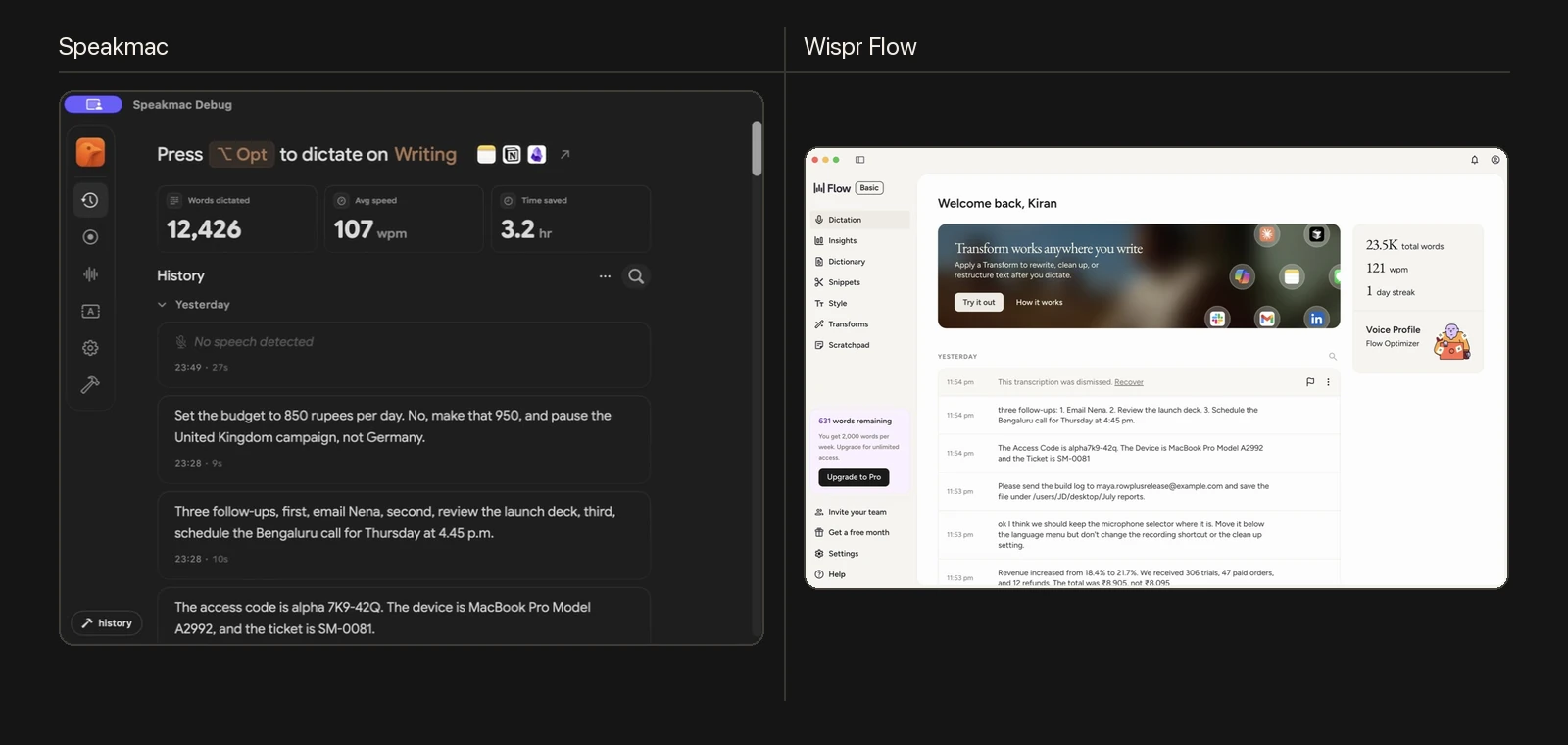
These are the native history screens from the extended run.
We reran the 27 licensed real-human clips only through the installed Speakmac 5.5.0 build 61. The command used Parakeet, on-device Clean Up Dictation, and the CLI flags --stdout --clean --no-history.
Speakmac scored 6.3% WER again: 22 errors across 349 reference words, exactly matching its Speakmac 5.2.1 result on this subset. It returned text on 27 of 27 clips. Three per-clip scores changed: one added three errors while two removed three errors between them, leaving the aggregate unchanged.
This is a Speakmac release-regression result, not a fresh Wispr Flow comparison. We did not rerun Wispr Flow, and the unchanged aggregate does not mean every per-clip output was identical.
The original experiment also included 10 stress clips rendered with macOS System Voices. Apple's macOS license does not permit public or commercial publishing or redistribution of that voice output, so those WAVs and their new 5.5.0 results are not in the public pack. The historical 37-row text tables remain for audit context, but only the 27 CC BY real-human clips are publicly reproducible.
Open the reproducibility guide, verify the corpus manifest, review attribution and exclusions, inspect the pinned runner, or download the 5.5.0 regression summary.
The 6.3% real-speech tie is 22 literal word errors for each app across 349 words. The paired 95% bootstrap interval for Speakmac minus Wispr Flow was −4.93 to +3.75 percentage points, so this corpus does not establish a universal accuracy winner.
The controlled clips were intentionally harder and more sensitive to editing. Across all 37 clips, Speakmac scored 15.7% WER and Wispr Flow 20.4%. That overall gap is materially affected by Flow's two no-output results, so it should not be read as “Speakmac is always 4.7 points better.”
Download the historical 37-row per-clip CSV, paired transcripts and scores, or summary with confidence intervals. The public corpus manifest covers the 27 licensed real-human WAVs only.
Treat the result as evidence about this corpus and these versions. To choose today, compare your own speech with matched cleanup settings and include failures, waiting and correction time. Current prices are in the Wispr Flow pricing guide and the Mac dictation pricing guide, separate from the historical July prices in the table above.
This benchmark used imported audio for Speakmac and a virtual audio route for Flow. It does not measure physical USB or Bluetooth startup, microphone gain, or the interval between live dictations. A quiet receiver recording can lose words before either model sees them. Use the microphone checklist and model guide for a live comparison.
Speakmac now offers recognition and cleanup choices separately. Its current controls and outputs need not match the historical screenshots above. Wispr Flow’s current product and plan details are on its official site and pricing page.